

Elora Tea
Castleton Estate - TGFOP Darjeeling
Castleton Estate - TGFOP Darjeeling
Couldn't load pickup availability
Wonderful muscatel highlights with delicate strength - the hallmark of a premium 2nd flush Darjeeling.
HEALTH PROPERTIES: High in anti-oxidants
GRADE: Finest Tippy Golden Flowery Orange Pekoe (FTGFOP)
CAFFEINE LEVELS: Medium
TEA SOURCING: India (Darjeeling)
THE STORY OF CASTLETON ESTATE
Second flush Darjeelings are typically more complex and fuller in the cup than the first Flush varieties, which tend to be a little greener and lighter. The term 'flush' refers to the pluck - or harvesting of the leaves. Darjeelings are among the rarest and most prestigious black teas. The best grades are the whole leaf types with lots of 'tip'. This tea is the grade F.T.G.F.O.P. (finest tippy golden flowery orange pekoe) and is in the upper 10 percentile of Castleton's quality. Put another way - the rarest of the rare.
Castleton estate is near the town of Kurseong in the Darjeeling district of northern India. Castleton is one of the top estates in Darjeeling and consistently produces top teas - and not surprisingly commands the top prices. We bring it in, as a customer in Elora (thanks John), special ordered it from us regularly, so we decided to make it available to all our customers. The major method of transportation from Darjeeling is via road (very treacherous) and a narrow gauge railway. In world terms the railway is almost considered a toy railroad system. The narrow gauge does not support large engines or carriages, and the steep inclines necessitate a cog system to prevent to trains from rolling backwards. Despite all the difficulties that must be contended with, the area produces the 'Champagne of Tea'.
Produced in the Himalayas, Darjeelings are grown in the shadow of Kangchenjunga, the snowcapped mountain said to be home of the Hindu God "Shiva" -the Destroyer. Darjeeling means land of the Thunderbolt and it is in fact the weather, combined with the attitude, soil and bright sunlight that result in an incomparable beverage.
The are 3 main times of year for producing good quality Darjeelings:
1st flush - Springtime harvested teas from late Feb. to mid-April. The young leaves yield a light tea with generally intense muscatel with 'point'. A gentle afternoon tea.
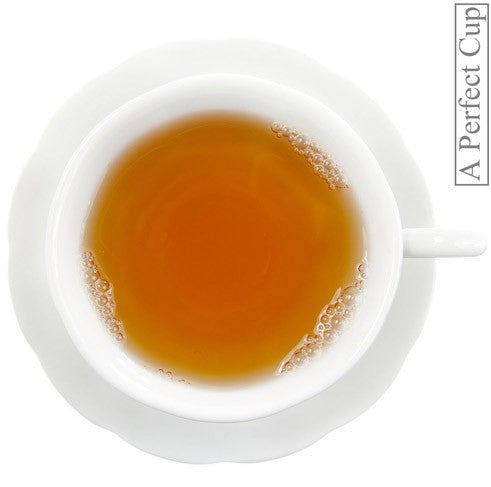
2nd flush - Harvested in June, these teas are more fully developed. The liquor is bright and the taste full and round, and has an excellent muscatel quality. A superb afternoon tea that is especially good with scones and raspberry conserve.
Autumnal - Not always available depending upon the weather, they are typified by a round taste and coppery liquor. Excellent as a breakfast tea with milk.
BREWING INSTRUCTIONS
BREWING INSTRUCTIONS FOR HOT TEA: Infuse one slightly heaping teaspoon for each 8 ounce cup with boiling water for 3-7 minutes.
Infuse 6 slightly heaping teaspoons of tea with 1 1/4 cups of boiling water for 5 minutes. Quarter fill a serving pitcher with cold water, and add the infused tea, straining the leaves, to the pitcher. Add ice and top-up the pitcher with cold water. Add lemon and sweeten to taste. A rule of thumb when preparing fresh brewed iced tea is to increase the strength of hot tea since it will be poured over ice and diluted with cold water.
Infuse 1 slightly heaping teaspoon of loose tea with 6 ounces of boiling water for 5 minutes. Add the tea to a 12 ounce glass, filled with ice, straining the leaves. Add hot tea to a 12oz/375ml acrylic glass filled with ice, straining the tea or removing the bags. Add lemon and sweeten to taste.
NUMBER OF CUPS: 15-20 cups from each 50 grams of tea, with a single use of the leaves. Loose leaf tea is traditionally infused 3 times, with a different flavor profile following each infusion. Accordingly, each 50 gram bag can make up to 60 cups of tea.
Share